
The AISES National Student Research Competition brings together Indigenous STEM students and professionals to showcase research that is scientifically rigorous and rooted in Indigenous values.
Judges evaluate each presentation with the Four Strands framework—Interest in STEM, Engagement & Belonging, STEM Competencies & Confidence, and Future Intentions—while honoring the CARE Principles (Collective Benefit, Authority to Control, Responsibility, Ethics).
This page answers the most common questions about abstract submission, presentation formats, judging criteria, and community‑impact categories.
- Who can participate in the student research competition?
Students from middle school through doctoral programs conducting any type of STEM research. This includes: Middle School (grades 6-8), High School (grades 9-12), Undergraduate Students (associate's or bachelor's programs), Master's Students, and Doctoral Students (PhD, EdD, or other doctoral programs).
All STEM fields and research approaches are welcome: lab experiments, field studies, community-based research, traditional knowledge integration, engineering projects, social science, and interdisciplinary work.
- When should I register after submitting my oral or poster research?
Once your research presentation is confirmed by AISES, you will receive the applicable registration discount code to register for the conference. Do not register for the conference before you receive a code! If you do register and pay in advance of receiving this code, your registration refund is subject to the Cancellation and Refund Policy.
- Can I present research I've presented elsewhere?
Yes, you can present research you've shared at other conferences, science fairs, or competitions.
Your AISES presentation uses our "What, So What, Now What" framework, which centers an Indigenous understanding of research: the researcher, the community, and the work are interconnected. You'll articulate your standpoint (who you are and how you came to this work), acknowledge the knowledge systems and relationships that inform your approach, and explain how your research benefits community (whether your tribal nation, your local area, your field, or the people your work serves). This Indigenous-centered lens helps you tell a complete research story that honors all these relationships.
- Can I submit if I'm still working on my research?
Yes! Works in progress are absolutely welcome. You don't need completed research or final results to participate. Many successful presentations share preliminary findings and early observations, research questions you're exploring, methods you're developing and testing, challenges you're working through, and next steps you're planning. What matters is that you can describe your process, share what you're learning so far, and explain why your research matters.
- When are the abstract submission deadlines?
Abstracts are accepted through Friday, September 4, 2026. Presentation capacity is limited; early submission is strongly encouraged.
Priority Deadline 1: Friday, July 24, 2026 (11:59 PM PST)
- Guaranteed review
- Accepted presenters receive complimentary registration
Priority Deadline 2: Friday, August 14, 2026 (11:59 PM PST)
- Priority review
- Accepted presenters receive 50% registration discount
Final Deadline: Friday, September 4, 2026 (11:59 PM PST)
- Reviewed on a space available basis
- Standard registration rates apply
- Can I edit my abstract after I submit it?
Yes, you can edit your abstract through STEMwizard until the submission deadline that applies to you (Priority 1, Priority 2, or Final). After the deadline, your abstract is locked for review.
Tip: Save your work frequently in STEMwizard, and consider drafting your abstract sections in a separate document first, then copying them into the submission form when ready.
- What's the difference between oral and poster presentations?
Both formats are valuable ways to share your research—the difference is in how you present and engage with your audience.
Oral Presentations: 10-minute presentation using slides + 5-minute Q&A, present to a seated audience in a conference room. Best for complex research requiring detailed explanation, projects with narrative arcs, researchers comfortable with public speaking.
Poster Presentations: Visual poster display + informal conversations with attendees, stand by your poster during assigned session times. Best for research that works well visually, early-stage or smaller projects, researchers who prefer one-on-one discussions.
You'll indicate your preference when submitting, but final format is determined by judges based on your research and conference scheduling. Both formats are evaluated using the same Four Strands rubric and are equally eligible for awards.
- How long is an oral presentation? What size should my poster be?
Oral Presentations
- Presentation time: 10 minutes
- Q&A time: 5 minutes
- Total session slot: 15 minutes
Poster Presentations:
- Standard size: 48" wide x 36" tall (landscape orientation)
- Format: Printed on single sheet or mounted on foam board,
- Session time: You'll be assigned 2-hour poster session blocks to stand by your poster.
Detailed specifications, templates, and preparation guidelines are provided in your acceptance notification and in the Research Competition Policies and Procedures (PDF).
- When will I know if my abstract is accepted?
Acceptance notifications are sent within 2 weeks of your submission deadline:
- Priority Deadline 1 (July 24): Notifications by early August.
- Priority Deadline 2 (August 14): Notifications by late August.
- Final Deadline (September 4): Notifications by mid-September.
Your acceptance email will include: Your presentation format (oral or poster), your registration discount code, presentation day and time, next steps and preparation guidelines, and technical requirements and specifications. If you don't receive notification within 2 weeks of your deadline, check your spam folder and contact research@aises.org.
- How are winners selected and when are awards announced?
Selection Process
All presentations are evaluated by 2-3 judges using the Four Strands rubric. Each presentation receives scores across the four strands (Interest in STEM, Engagement & Belonging, STEM Competencies & Confidence, and Future Intentions). Judges also provide optional feedback. Scores from multiple judges are combined to create composite scores. The highest-scoring presentations in each category are recognized: Awards by educational level (middle school, high school, undergraduate, graduate) and awards by presentation format (oral and poster).Awards Announcement
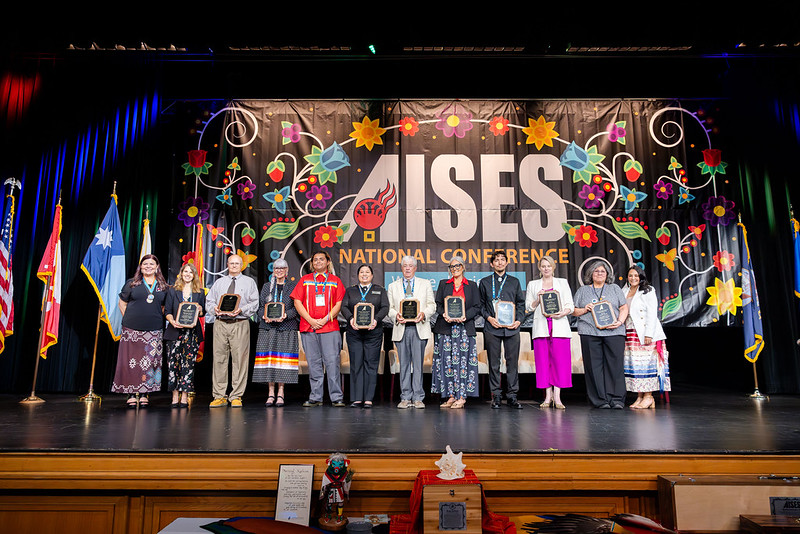
Winners will be recognized on Saturday, October 17, 2026 during the AISES National Conference. Details about the recognition ceremony will be provided to all presenters closer to the conference date.For complete evaluation criteria and scoring details, see the Research Competition Policies and Procedures (PDF).